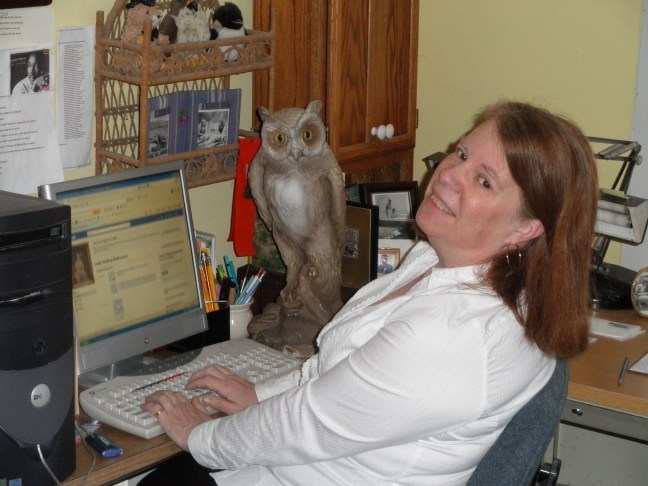
I’ve been going through my books. The area in the house that’s devoted to my bookshelves has looked–to me, anyhow–dusty, books jammed in at odd angles. So I’m doing a huge reorganization of all the shelves.
In going through this heap of books I’ve found photos, worn out paperbacks that are slowly disintegrating, a huge envelope full of poetry that I wrote in the 70s–and it is so embarrassing that I only read one poem and bundled the fat envelope away, on a bottom shelf. It’s obvious that I hadn’t found my “writer’s voice” yet.
I forgot that I had been going through a phase of wanting to learn more about Pittsburgh history; I have a small collection of books about that. They were all interesting but for some reason that only my heart knows, I put them on a shelf that’s hard to see. I’m enjoying living in the present. I remember an interesting fact that I learned from one of those books; where we lived, on Shady Ave. Ext., was one of the oldest parts of Pittsburgh. When my friends and I would play in the spooky cemetery that’s next to a gloomy church nearby, we didn’t know that this place was the oldest church and churchyard to be established. And of course Brown’s Hill Road led straight to the Monongahela.
It’s a known fact that we can live in a place and not see or notice many aspects of it.
I’ll start out my Pittsburgh Experiences Series with this story that I read while going through my “learning about Pittsburgh” phase. In Philadelphia, life was refined and like the cities in Europe, had the best culturally. (Not all of life was “refined” there, obviously. But there were “nice” places to live,” “good restaurants,” and music.)
If a man met a woman in Philadelphia and wanted to marry her, it was assumed by the girl’s parents that the couple would reside in Philadelphia. But there’s a story about a man meeting a woman and wanting to “take her to Pittsburgh.” Shock and outrage on the part of the parents. Just traveling through our still heavily-wooded state was at best, a nightmare. No roads–maybe a few paths to follow–the trip would take days, maybe weeks. Then once arriving, this sheltered young girl would find a city in constant turmoil, public drinking, fighting, brothels. Called the “Doorway to the West” because ambitious men going west, tough fortune-hunters, trappers and more would use Pittsburgh as a base of operations and a place to buy guns, ammunition, foodstuffs–it was “diametrically opposed” to refined, relatively clean Philadelphia. In the story I read, the young lady found that she liked the release from stuffy society and her grateful, happy husband built her the biggest house in Pittsburgh at that time.
 lgmwriting